


Thanks for reading Educating AI! Tool-agnostic AI literacy sounds principled until you realize students are navigating actual platforms with real constraints that shape what literacy even means. This piece bridges infrastructure analysis and literacy work, showing why understanding system design isn't optional. It's foundational. If you value journalism that connects technical architecture to educational outcomes, consider supporting our work with a paid subscription.
The faculty meeting had been going for forty minutes, and nobody was actually disagreeing.
“We need to teach AI literacy,” said the technology coordinator, pulling up a slide about prompt engineering workshops.
“Absolutely,” nodded the English department chair. “That’s why I’m worried about students using ChatGPT on their essays. We need clearer policies.”
“But isn’t the whole point to prepare them for a world where they’ll use these tools?” countered the STEM coordinator. “We just adopted this adaptive learning platform that uses AI to personalize practice problems.”
The principal, sensing tension, tried to clarify: “So we’re all in agreement that AI literacy is the priority?”
Everyone nodded. Nobody agreed on what that meant.
The Problem We’re Not Naming
Here’s what’s actually happening in schools right now: AI is everywhere, operating at completely different levels, serving entirely different purposes, requiring radically different kinds of student competency. But we’re using the same phrase, “AI literacy,” to describe all of it.
A student deciding whether to use an unauthorized AI tool at home to help with a research project is engaging in a fundamentally different kind of thinking than a student working through an AI-powered math tutoring system that tracks their progress toward specific learning objectives. Both involve AI. Both require some form of literacy. But treating them as the same thing, or worse, assuming one prepares students for the other, creates confusion that’s stalling thoughtful AI integration across education.
We need better language. More specifically, we need a framework that helps educators, administrators, and AI literacy specialists talk precisely about which kind of AI interaction they’re focusing on, what it demands from students, and how it fits into a broader strategy.
Introducing System Altitude
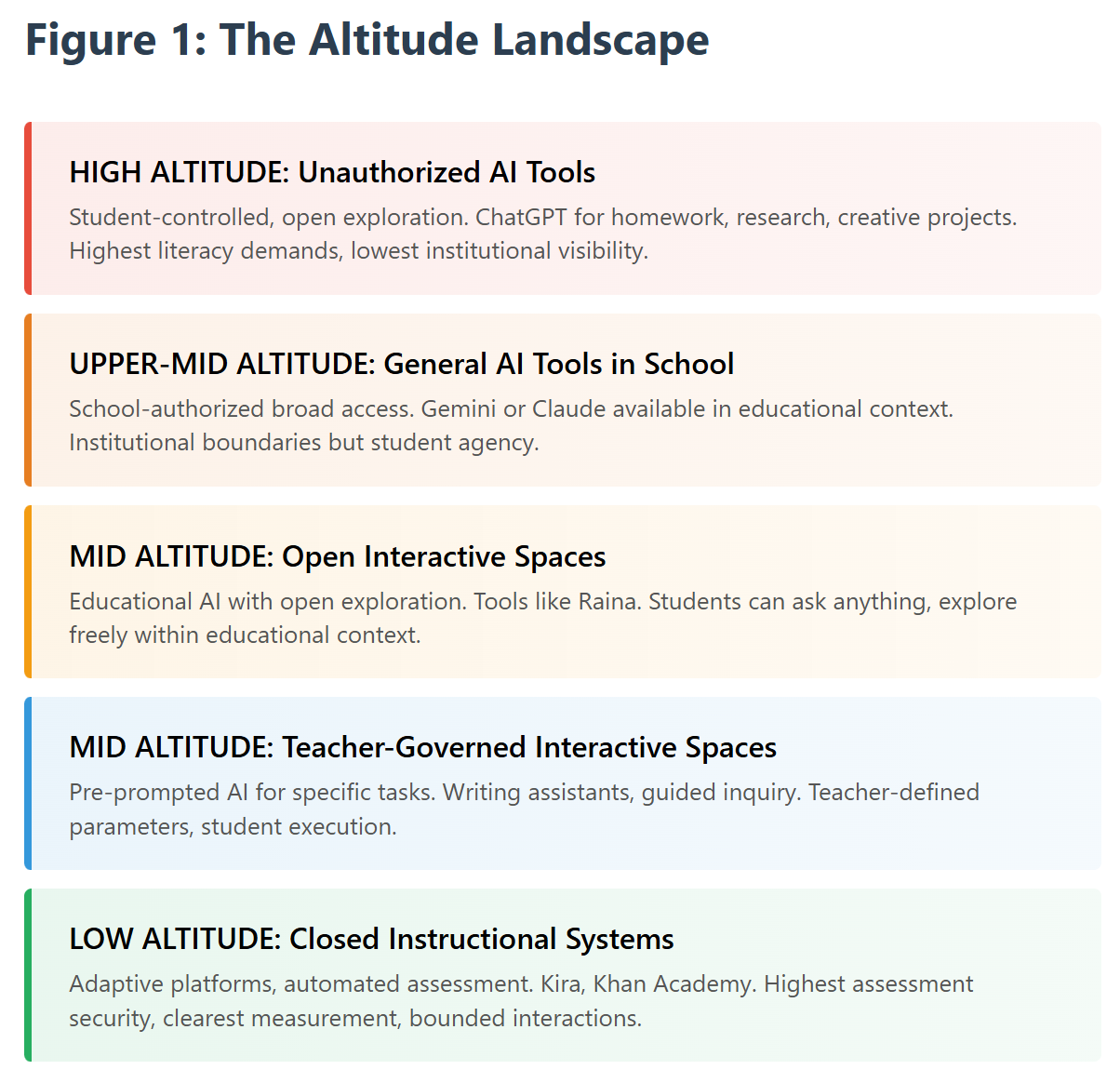
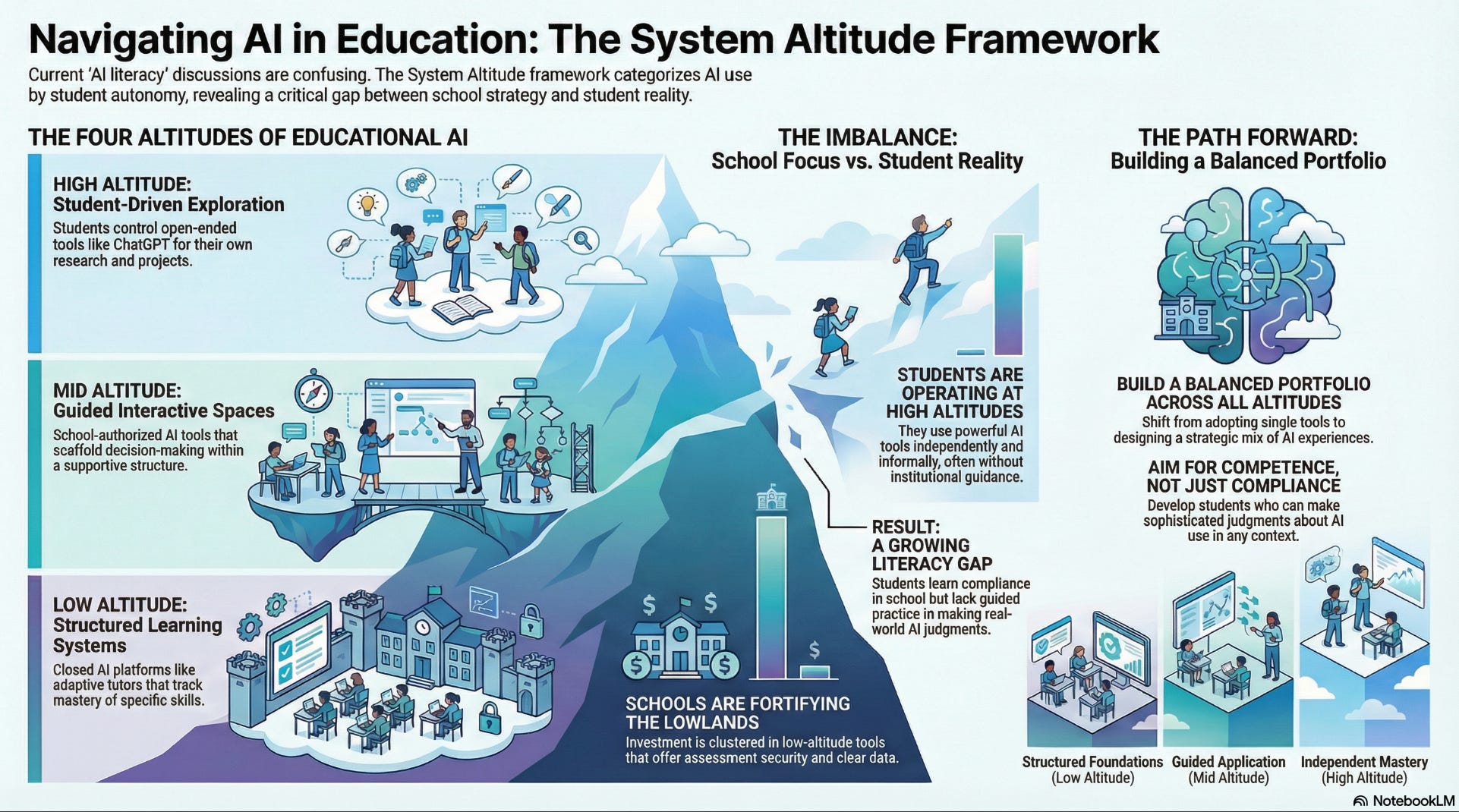
Think of AI use in education as operating at different altitudes. At the highest altitudes, students are making broad decisions about their own AI use. These are choices that transcend the authorized/unauthorized or school/home distinctions. At the lowest altitudes, students are working within tightly bounded AI-powered systems designed to measure specific competencies.
High Altitude: Unauthorized AI Tools Students using ChatGPT, Claude, or Gemini outside of school structures for homework, projects, creative work, or research. The student controls everything: which tool, which task, how to use it, whether to use it at all.
Upper-Mid Altitude: General AI Tools in School School-authorized access to tools like Gemini or Claude within the educational environment. Students have broad access but within institutional boundaries.
Mid Altitude: Educational AI Interactive Spaces Purpose-built educational AI tools with interactive capabilities. But even here, there are crucial distinctions. Open interactive spaces like Raina allow students to ask any question and explore freely. Teacher-governed interactive spaces feature AI that is pre-prompted to support specific tasks, like a writing assistant focused on a particular assignment.
Low Altitude: Closed Instructional AI Systems AI tools operating within highly structured parameters that track student progress across interactions, measure mastery, and provide data to educators. Think adaptive learning platforms, automated assessment systems, AI tutoring with predetermined learning paths.
The altitude isn’t about quality or value. It’s about the kind of thinking and decision-making required from students.
Three Dichotomies That Define the Terrain
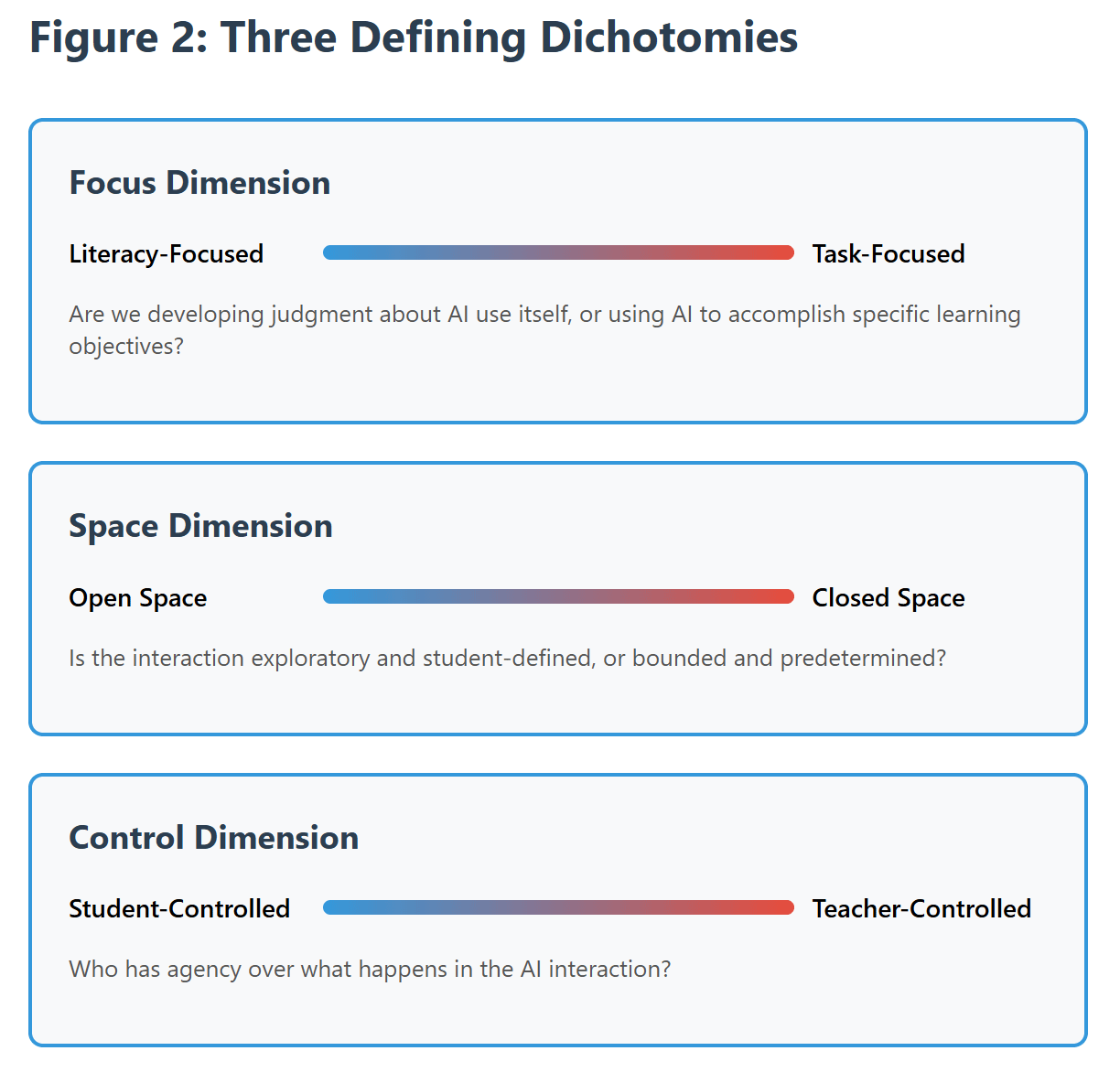
System altitude is actually shaped by three intersecting dimensions:
1. Literacy-Focused vs. Task-Focused
At high altitudes, the emphasis is on developing judgment about AI use itself: When should I use this? How does this tool work? What are the ethical implications? What can’t this tool do that I need to do myself?
At low altitudes, AI is a means to an end: The focus is on demonstrating mastery of math concepts, improving reading comprehension, or completing a structured learning sequence. The AI literacy required is narrower, understanding how to interact with this particular tool to accomplish this particular goal.
2. Open vs. Closed Instructional Spaces
Open spaces are exploratory and student-defined. The interaction could go anywhere. A student using ChatGPT for research might explore tangents, test different approaches, or pivot their entire project based on what they discover.
Closed spaces are bounded and predetermined. The possible interactions are mapped in advance. An AI math tutor might adapt to student responses, but it’s adapting within a defined scope toward specific learning objectives.
3. Student-Controlled vs. Teacher-Controlled
Who has agency over what happens? At high altitudes, students typically control the interaction. At low altitudes, teachers typically define the parameters. But this dimension is actually orthogonal to altitude. You can imagine teacher-controlled high-altitude experiences, like a teacher requiring students to use AI tools and reflect on their choices. Or student-controlled low-altitude work, where students choose which practice exercises to complete in an adaptive system.
These three dichotomies create a complex landscape of possibilities. Understanding where a particular AI interaction sits along each dimension helps us be precise about what we’re asking of students and what kind of literacy we’re trying to develop.
Where Schools Actually Are (vs. Where They Think They Are)
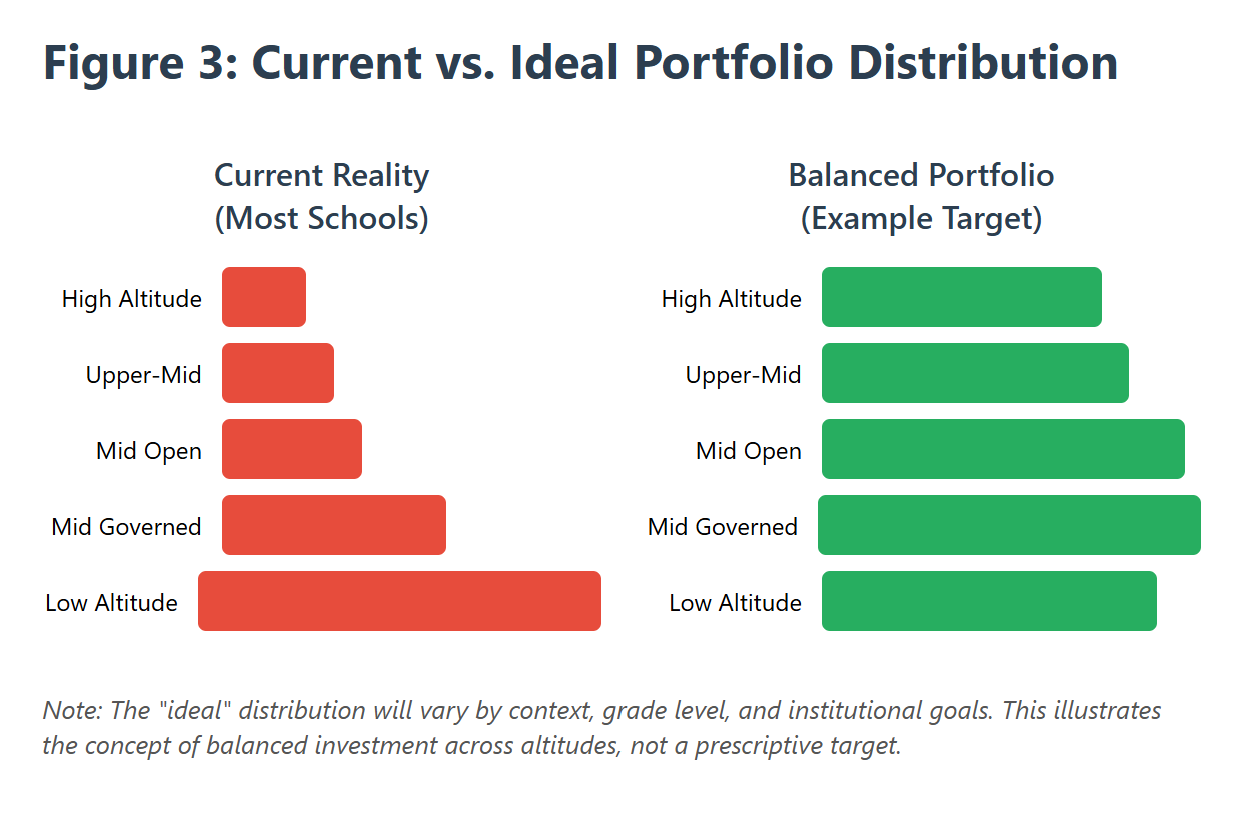
Here’s the uncomfortable truth: Most institutional AI investment is clustering at low altitudes. Schools are adopting adaptive learning platforms, AI-powered assessment tools, automated feedback systems. This makes sense, and not just because these tools are easier to sell to school boards.
Low-altitude tools offer something genuinely valuable: assessment security. They provide clear evidence that learning is happening. They generate data that teachers, students, and parents can interpret. They create accountability structures that protect both students and educators. When a student works through an AI-powered math system, we can see their progress, identify misconceptions, demonstrate growth. This isn’t just institutional anxiety, it’s responsible pedagogy. We should be able to show that our educational interventions are working.
Moreover, low-altitude tools can provide equitable access to personalized support at scale, reduce time spent on busywork, and create structured learning pathways for students who need them.
Meanwhile, students are already operating at high altitudes. They’re using ChatGPT for homework. They’re asking Claude to explain concepts their teacher covered. They’re generating first drafts, debugging code, brainstorming ideas. But they’re doing this in the shadows, without institutional guidance, ethical frameworks, or systematic literacy support.
Schools have effectively abandoned the high ground while fortifying the lowlands.
The result? Students are developing one kind of AI literacy, how to work effectively within structured AI systems, while a completely different kind of literacy, navigating open-ended AI decisions across contexts, is being developed informally, unevenly, without institutional support. Both matter. The literacy that develops at low altitudes is real and valuable. The literacy needed at high altitudes is equally essential. But the portfolio is unbalanced, and the gap between where schools operate and where students actually live with AI is growing.
The Case for a Portfolio of Altitudes
The solution isn’t to abandon low-altitude work for high-altitude work. Both are necessary. What schools need is a portfolio approach across altitudes.
Low-altitude work provides structured skill development with clear assessment. It’s not going away, nor should it. Students benefit from AI-powered practice that adapts to their level, from feedback systems that help them improve specific competencies, from tools that make certain kinds of learning more efficient.
But low-altitude work has limitations. It doesn’t build the judgment students need when they’re outside those bounded spaces, facing open-ended decisions about whether and how to use AI.
High-altitude work develops exactly that judgment. It creates opportunities for students to grapple with real decisions, experience consequences, build mental models of AI capabilities and limitations, and develop ethical frameworks that transfer across contexts.
Mid-altitude work, interactive educational AI spaces with varying degrees of openness and control, serves as crucial scaffolding. This is where students can practice higher-altitude decision-making within supportive structures, where thinking can be made visible, where educators can gather evidence of developing judgment without reducing it to standardized metrics.
A healthy portfolio includes all of these. The specific balance might vary based on grade level, subject area, student population, and institutional context. But every school should be able to answer: Where are our students getting experience across this range? How are we scaffolding progression from more structured to more autonomous AI use? What does our current portfolio actually look like versus what we think it looks like?
The Measurement Challenge (And Why We Need to Be Honest About It)
Here’s where it gets complicated. We want to be able to measure AI literacy and demonstrate that our efforts are working. The idealistic “just teach everyone to make good choices” approach may only work for certain students, and without evidence, how do we know our literacy work is successful?
This tension is real, and the framework doesn’t resolve it, but it does clarify it.
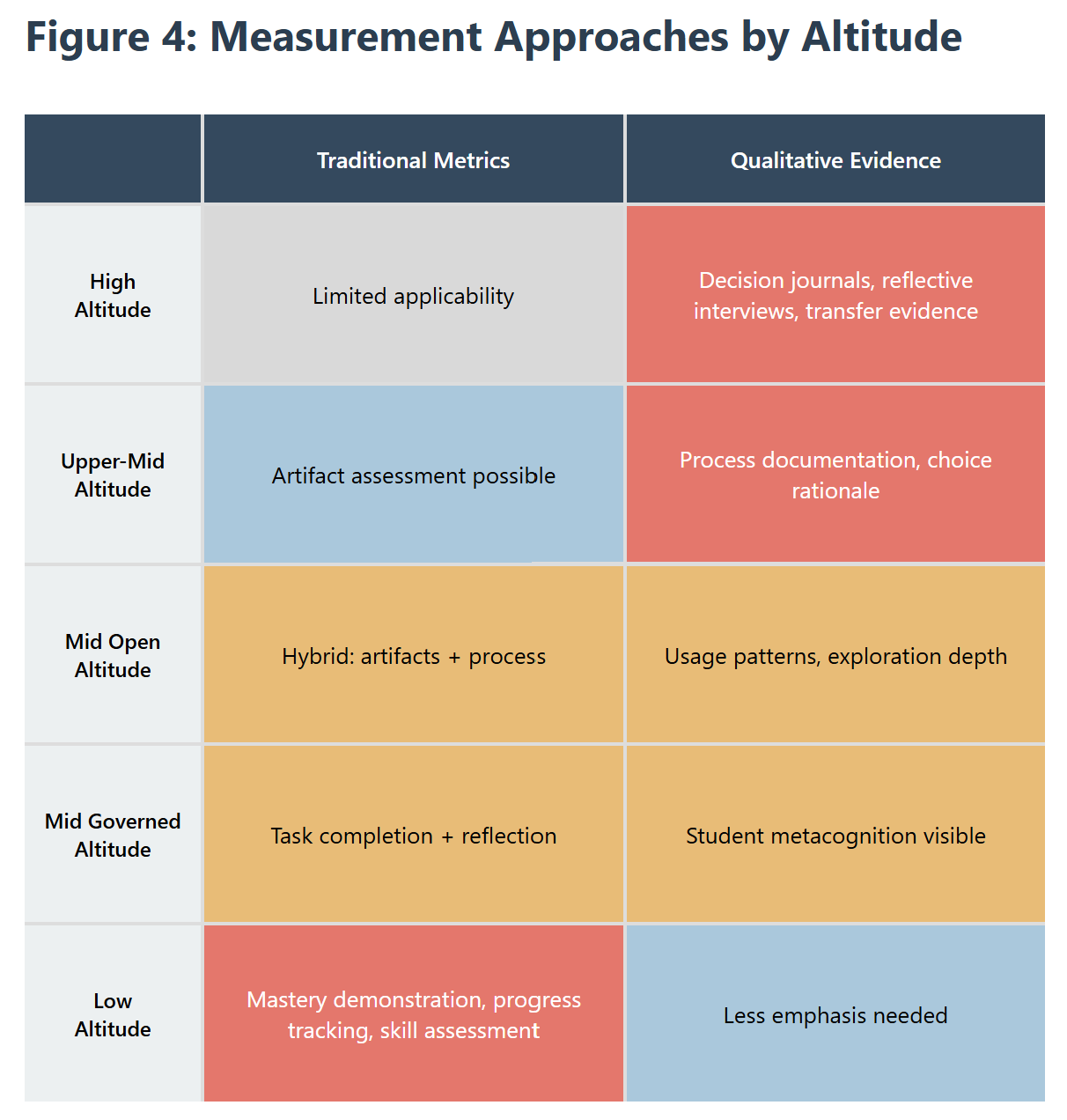
Different altitudes require different measurement logics:
At low altitudes, traditional metrics work fine. Did the student master the concept? Can they solve the problem? Demonstrate the skill? The AI is part of the instructional delivery system, and we can measure learning outcomes the same way we always have.
At mid altitudes, we need hybrid approaches. We can assess the artifacts students create and ask them to reflect on their process. We can examine patterns of tool use over time. We can use formative assessment to understand developing competencies without reducing everything to scores.
At high altitudes, we need entirely different evidence. Traditional assessment doesn’t capture what matters most: transfer across contexts, long-term decision-making patterns, internalized values. Instead, we might look at process documentation, where students maintain decision journals about their AI use. We might use case analysis, where students explain their reasoning about when and how they used AI across different contexts. Reflective interviews can surface student thinking about AI capabilities, limitations, and ethics. Longitudinal patterns track choices students make over months, across different situations. Transfer indicators provide evidence that students can articulate why they made different AI choices in different contexts.
This isn’t “no measurement.” It’s different measurement. It’s acknowledging that the outcomes we care about most at high altitudes resist the mechanisms schools traditionally use to demonstrate effectiveness.
And yes, this creates challenges. High-altitude literacy work is harder to justify in resource allocation conversations. It doesn’t produce the clean data points that administrators can present to school boards. It requires trust, professional development, and a different assessment culture.
But here’s the alternative: If schools only invest where measurement is easy, they create a two-tier system. Some students, typically those with more resources and access at home, develop real AI literacy informally. Others learn only to be compliant users of school-approved tools. The equity implications are stark.
Moving Forward: What Changes When You See Your AI Work as a Portfolio?
Adopting a portfolio approach across altitudes shifts the conversation in several crucial ways:
From “which altitude is best?” to “what does balance look like for our context?”
Different schools, grade levels, and student populations will weight their portfolios differently. The framework provides language to be intentional rather than reactive.
From tool adoption to strategic design:
Instead of asking “should we buy this AI platform?” schools can ask “what altitude does this operate at, and does it fill a gap in our portfolio or double down on where we’re already strong?”
From binary policies to developmental progressions:
Rather than blanket “AI allowed” or “AI prohibited” stances, schools can design experiences that scaffold students from more structured to more autonomous AI use, with clear reasoning about when students are ready for higher-altitude work.
From compliance to competence:
The goal shifts from preventing inappropriate AI use to developing students who can make sophisticated judgments about appropriate use across contexts, a skill that will matter long after they leave our institutions.
From invisible to visible:
Currently, high-altitude AI use is happening but hidden. Making it part of the educational portfolio brings it into spaces where it can be discussed, examined, and developed systematically.
The Work Ahead
This framework won’t resolve all the tensions around AI in education. It won’t make measurement easy. It won’t eliminate disagreement about priorities or policies.
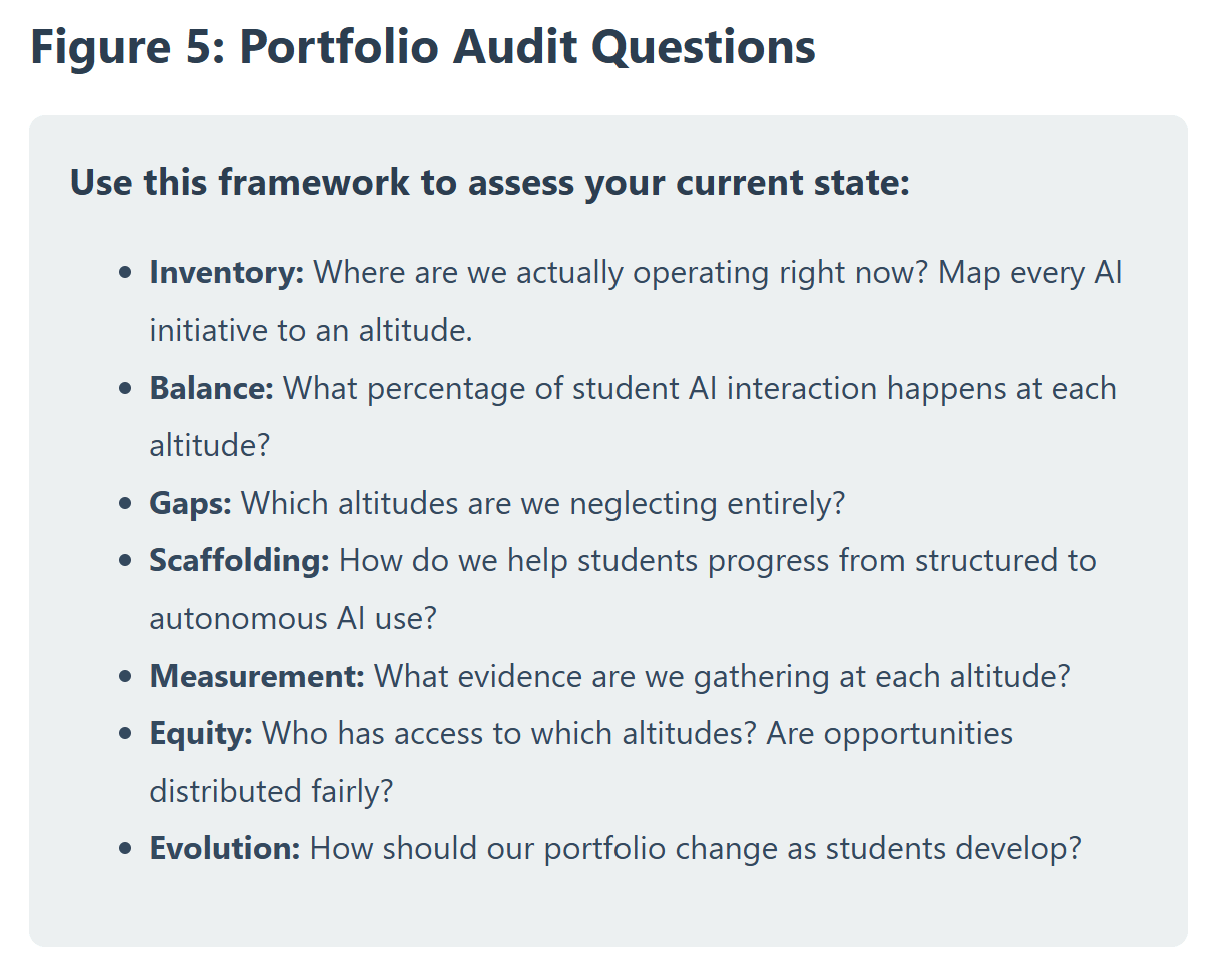
But it gives us better questions:
Where is our portfolio unbalanced?
What altitudes are we neglecting entirely?
How are we scaffolding students from structured to autonomous AI use?
What does success look like at each altitude, and what evidence would convince us we’re achieving it?
How does our portfolio need to evolve as students develop?
The faculty meeting at the beginning of this article? Those educators weren’t actually in conflict. They were operating at different altitudes, talking about different kinds of AI literacy, addressing different real needs. With shared language, they could have a more productive conversation about how their different efforts fit together into a coherent strategy.
That’s the value of system altitude: not prescribing answers, but providing the framework to ask better questions. Because right now, we’re not just unclear about AI literacy. We’re unclear about our lack of clarity. And that’s the first problem to solve.
What does your school’s AI portfolio look like? Where are the gaps? What would it take to build across all altitudes? Share your thoughts in the comments.
Mike Kentz’s AI EduPathways: Insights from one of our most insightful, creative, and eloquent AI educators in the business!!!
Terry Underwood’s Learning to Read, Reading to Learn: The most penetrating investigation of the intersections between compositional theory, literacy studies, and AI on the internet!!!
Suzi’s When Life Gives You AI: A cutting-edge exploration of the intersection among computer science, neuroscience, and philosophy
Alejandro Piad Morffis’s The Computerist Journal: Unmatched investigations into coding, machine learning, computational theory, and practical AI applications
Michael Woudenberg’s Polymathic Being: Polymathic wisdom brought to you every Sunday morning with your first cup of coffee
Rob Nelson’s AI Log: Incredibly deep and insightful essay about AI’s impact on higher ed, society, and culture.
Michael Spencer’s AI Supremacy: The most comprehensive and current analysis of AI news and trends, featuring numerous intriguing guest posts
Daniel Bashir’s The Gradient Podcast: The top interviews with leading AI experts, researchers, developers, and linguists.
Daniel Nest’s Why Try AI?: The most amazing updates on AI tools and techniques
Jason Gulya’s The AI Edventure: An important exploration of cutting-edge innovations in AI-responsive curriculum and pedagogy.
Stephen Fitzpatrick’s Teaching in the Age of AI: Essential reflections from a veteran high school educator on the challenges and opportunities of generative AI in the classroom!!!