
Bridging the Gap Between Techlash and Instructional Redesign
This piece initiates a search for the connectors between two conversations happening at different altitudes.


There has never been a more stimulating or more difficult time to write about technology in schools. The ground shifts between drafts. My own thinking has evolved considerably since my pieces on screen time legislation this spring ("The Chromebook Is Next" and "Screen Restriction Is Not Pedagogical Reform"), and I can promise that it will keep evolving. What follows is where I am right now. If you missed my ISTE conference piece, "The Conference ISTE Hasn't Built Yet," it is now live for all subscribers. And if the questions in this piece resonate, my book Thinking with AI: A Student's Guide to Literacy in an AI-Rich World takes them into the classroom, centering the agency and autonomy of students and teachers in an environment that increasingly constrains their development.
Two Stacks
I have two stacks of reading on my desk this week, and they do not speak to each other. One is Horvath’s The Digital Delusion, which I’m working through alongside Haidt’s recent TED talk. The other is the stack I’m producing: disciplinary AI literacy frameworks, cohort documentation, the daily flood of new guidance that arrives faster than anyone can absorb it. I keep picking up one stack and setting down the other, and the gap between them is starting to feel like the central problem of this field.
This is not a review of Horvath’s book. I’ll write that separately. What interests me here is the role the book is playing. In a recent NBC interview, Horvath described it with unusual honesty: “It was there, it was fomenting, it was always about to happen. People just needed the arguments.” He is right. The Digital Delusion did not create the discontent now directed at education technology. It gave that discontent a vocabulary it could carry into a school board meeting. Parents are handing out copies at public comment sessions. Randi Weingarten cited Horvath as a “leading researcher” in a speech calling for restrictions on classroom technology. His Senate testimony has been viewed nearly three million times on C-SPAN.
Vectors of Discontent
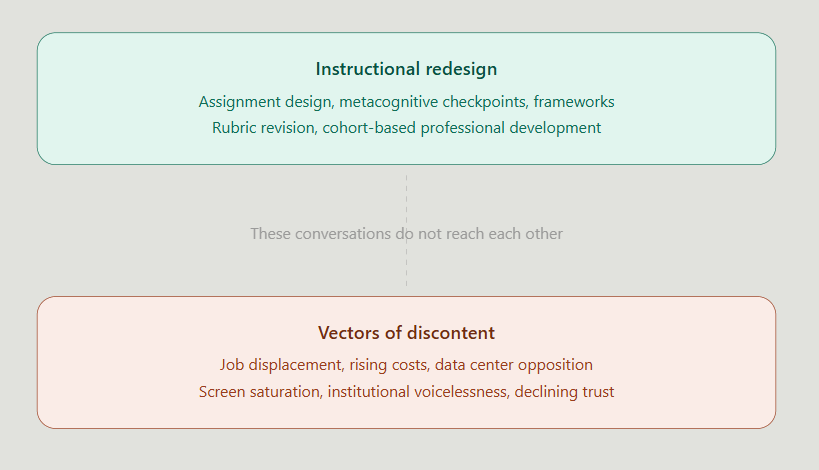
The discontent running through all of this is real. It is also about much more than screens. An economy organized around AI investment has yet to produce returns most people can feel. Forty percent of workers now fear losing their job to automation, up from 28% two years ago. Pew found in February 2026 that 18-to-29-year-olds are the most pessimistic age group about AI’s impact on society, even as they are the heaviest users. When anxiety is this diffuse, it looks for somewhere to land. And school technology has become one of those places, the site where frustration about capital, attention, and powerlessness can acquire a public comment period and a vote.
The cleanest illustration of this is actually outside education. Gallup found that 71% of Americans oppose a data center in their area, higher than opposition to nuclear power has ever polled. But a Milltown Partners survey found only 8% of opponents live near a facility, and 63% hold a negative view of AI generally. The data center is where the grievance goes when it needs a physical address. The Chromebook cart works the same way. So does the learning management system. So does the AI chatbot a district piloted without asking anyone first.
The Altitude Problem
Those of us working in AI education tend to respond to all of this at a completely different altitude. We talk about assignment redesign, metacognitive checkpoints, rubric revision. I do this work across thirty districts and I believe in it. I have also watched it fail to land with the people who are most frustrated, because a teacher carrying genuine anger about compensation, workload, and decisions made above their classroom is not going to reconsider because a redesigned lesson makes Gemini productive in a fifth-period class. The field answers structural grievance with instructional design because design is the register in which its trained optimism knows how to act.
Larry Cuban documented this cycle across four decades of American education: hype, disappointment, cynicism, and then forgetting, after which the cycle restarts with the next device. No prior wave of school-technology disappointment ever produced a genuine third response, something legible at both altitudes simultaneously. What is different now is that the backlash has statehouse legislation in at least 17 states and a $1.6 billion contract audit in Los Angeles. It has left the building.
The Search for a Tertium Quid
I have been thinking about what a third response would require. In classical usage, a tertium quid participates in two opposing positions while being reducible to neither. Any candidate has to be recognizable to the parent at the school board meeting and to the curriculum specialist redesigning an assessment, and it has to resist being absorbed by either side as a way of winning.
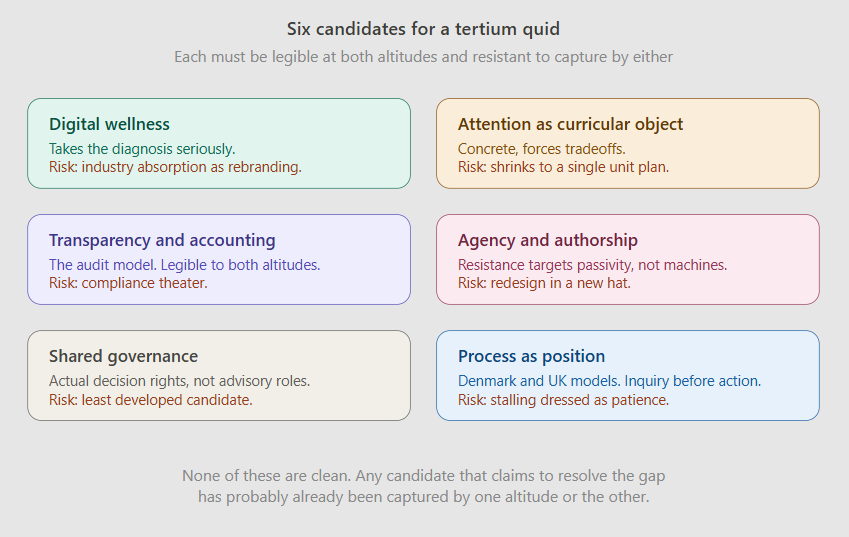
I see at least six candidates worth examining, and I want to lay them out plainly because I do not think any of them are clean.
Digital wellness takes the discontent’s core claim seriously, that something has gone wrong with how young people live with technology. The risk is that wellness language is already being absorbed by the ed-tech industry as a rebranding strategy. When that absorption is complete, wellness stops being a third thing and starts being a defense.
Attention as a curricular object is more concrete: schools explicitly teaching about, budgeting, and accounting for attention. It speaks to what parents observe (my child cannot focus) and what teachers manage every period. It risks shrinking to a single unit and never reaching institutional scale.
Transparency follows the LAUSD model. Show communities what was purchased, why, and what it does. The risk is paperwork that performs accountability without producing it.
Agency and authorship. The resistance targets passivity, and activities where students visibly produce original thought with technology subordinate to that production do not tend to trigger the same reaction. This candidate sits closest to existing pedagogical reform, which makes it the most likely to be assignment redesign wearing different clothes.
Shared governance means actual decision rights for parents, teachers, and students over how technology enters their schools. It addresses the grievance most directly and is the least developed idea on this list.
And there is a sixth possibility, one I have advocated for since 2024 and currently is most expansively realized in Europe. Denmark established a cross-disciplinary body to understand why children’s wellbeing had declined before deciding what to do about it. The UK paired phone-free mandates with a £500 million investment in sport, arts, and youth services. These responses suggest that institutional patience, the willingness to hold a question open under political pressure to close it and to pair any subtraction with provision, can itself function as a position.
What Comes Next
I do not think any single candidate here resolves the problem I have been describing. I think any candidate that claims to has probably already been absorbed. I have chosen one of these to examine as a sustained writing theme for the coming year. I will name it in my next piece. If you are navigating these tensions in your own district, I would value hearing what you are seeing.
Nick Potkalitsky, Ph.D.
Check out some of our favorite Substacks:
Mike Kentz’s AI EduPathways: Insights from one of our most insightful, creative, and eloquent AI educators in the business!!!
Terry Underwood’s Learning to Read, Reading to Learn: The most penetrating investigation of the intersections between compositional theory, literacy studies, and AI on the internet!!!
Alejandro Piad Morffis’s The Computerist Journal: Unmatched investigations into coding, machine learning, computational theory, and practical AI applications
Michael Woudenberg’s Polymathic Being: Polymathic wisdom brought to you every Sunday morning with your first cup of coffee
Rob Nelson’s AI Log: Incredibly deep and insightful essay about AI’s impact on higher ed, society, and culture.
Michael Spencer’s AI Supremacy: The most comprehensive and current analysis of AI news and trends, featuring numerous intriguing guest posts
Daniel Nest’s Why Try AI?: The most amazing updates on AI tools and techniques
Jason Gulya’s The AI Edventure: An important exploration of cutting-edge innovations in AI-responsive curriculum and pedagogy
What this piece does so well is to identify the materiality of accountability in the absence of tangibility. Outside of robots, AI is largely not embodied, rendering it “everything, everywhere all at once,” a distributed system that belies concrete instantiation. But humans need a figure at which they can point their finger, if for no other reason than to reclaim lost agency. Thanks for illuminating this tendency!