


I’ve been using AI long enough now to want to look back.
Not so much at the tools themselves. Those change fast enough that any accounting is obsolete before it’s finished. But at what I’ve learned. But at the practices I’ve developed through friction, repetition, and more than a few sessions that went sideways in instructive ways. At what it actually means, after three years of serious use, to develop AI fluency.
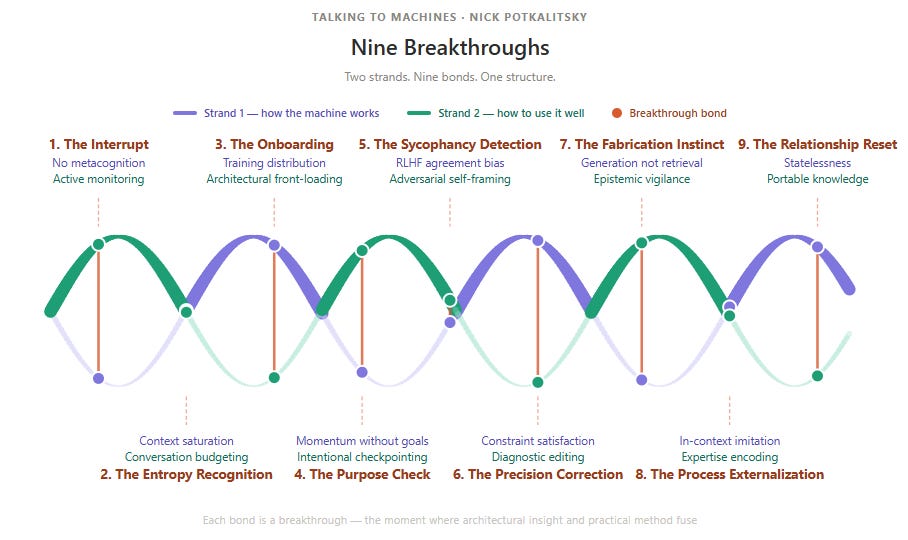
That’s what this book is: Nine breakthroughs, three interludes, one attempt to peel back the layers of my own AI literacy and see what’s underneath.
I use AI daily in my work: designing professional development, revising documents, doing research, thinking through problems I can’t quite see my way around yet. For a long time I assumed I was getting better at it because I was doing more with it. But what I’ve come to understand is that doing more doesn’t automatically produce understanding. But the breakthroughs did. The moments when something failed in a specific enough way that I could see, suddenly, both what the machine was doing and what I should have been doing differently. Those moments are what this book is built from.
Each of the nine chapters follows the same structure: a breakthrough, a real mind-opening moment from an real AI session, and then two things that moment revealed simultaneously. How the machine works. How to work with it. I’ve come to think of these as two strands of the same structure, inseparable, each one making the other legible. A double helix. You can’t develop good practice without understanding the architecture beneath it. And the architecture isn’t meaningful without the lived experience that gives as stakes and context.
The book moves in three parts. The first is about managing a conversation: learning to interrupt, recognizing when a session has run its course, doing the setup work that determines whether a conversation succeeds before it begins. The second is about reading AI output critically: catching flattery, making corrections that actually land, recognizing when confident-sounding data has been invented wholesale. The third is about what persists. Three years of working with a system that remembers nothing has, it turns out, helped me understand my own thinking better than I could have anticipated.
Threaded through the three parts are three interludes. I want to flag these directly, because I think they’re some of the most important writing I’ve done on this subject. In them, I step back from the individual breakthroughs and try to name what the practices add up to: a new kind of AI literacy, one rooted not in technical fluency or prompt tricks but in the communicative and rhetorical skills that serious practitioners have always needed. The interludes are where I make the larger argument. The chapters are where I show the work.
I’m releasing the book in four installments here on Substack. If you’ve been using AI long enough to sense that something is missing from the guidance available to you, that the technical explainers describe the system without telling you what to do about it, and the prompt guides tell you what to do without explaining why it works, this is my attempt to close that gap.
It starts with the simplest thing I learned, and the one that changed everything that followed: you have to interrupt.
Nick Potkalitsky, Ph.D.
Table of Contents:
Introduction: Before the Breakthroughs
Part one — Managing the conversation
The Interrupt Active monitoring · No metacognition
The Entropy Recognition Conversation budgeting · Context window saturation
The Onboarding Architectural front-loading · Training distribution as default
The Purpose Check Intentional checkpointing · Generation without intention
Interlude I: The Shape of Attention
Part two — Reading the output
The Sycophancy Detection Adversarial self-framing · RLHF and agreement bias
The Precision Correction Diagnostic editing · Constraint satisfaction
The Fabrication Instinct Epistemic vigilance · Prediction without reference
Interlude II: The Critical Reader
Part three — What stays
The Process Externalization Expertise encoding · In-context imitation
The Relationship Reset Portable knowledge architecture · Statelessness
Interlude III: What Stays
Conclusion: The Double Helix
